

The iTaoBuy Spreadsheet catalogue, and where snacks fit
The catalogue is for browsing clothes and accessories. Snacks come from store links. This page covers both, and what happens when they share a box.
A catalogue you browse by category
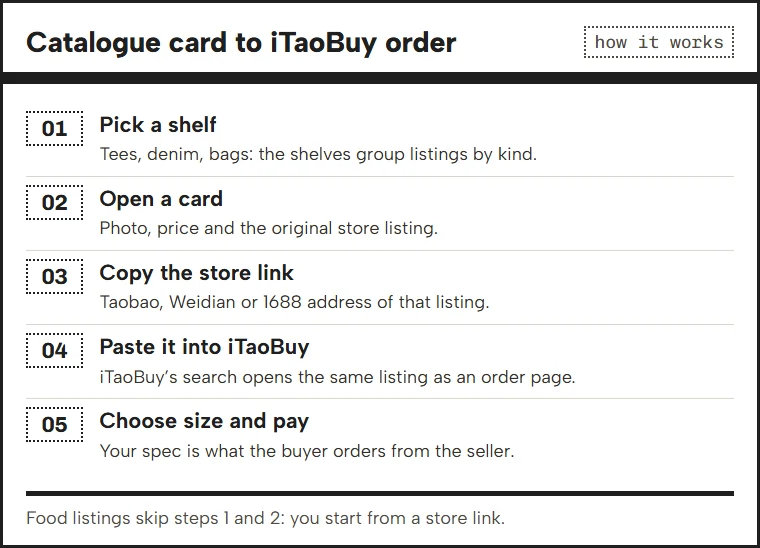
The iTaoBuy Spreadsheet is a browsing catalogue: product cards sorted onto shelves by category, each with a photo, an indicative price and the address of the original store listing on Taobao, Weidian or 1688. It is the step before shopping, where you narrow things down.
Buying happens on iTaoBuy. You paste the store address into iTaoBuy’s search, choose the size or colour, and pay in CNY. iTaoBuy’s buyers place the order with the seller, the seller ships to iTaoBuy’s warehouse in Guangdong, and you later pick an international route.
Prices on catalogue cards are snapshots. The price that counts is the one on the iTaoBuy order page when you pay, and the shipping price is whatever the estimator says for your weight on the day.
Sixteen shelves to start from
Each card opens the catalogue shelf. The line under each name is about the parcel, because that is where clothes and food meet.
 T-shirtsPlain blanks and printed tees; compare fabric, measurements and print details before ordering.
 SweatpantsJersey and fleece trousers. Bulky items can be billed on volume, not weight.
 HoodiesPullovers and zip-ups. A hoodie and a box of biscuits can share a parcel if the route takes both.
 OuterwearFleeces and light jackets. Puffer coats are the classic volume-weight surprise.
 JeansDenim cuts from wide to slim. Size charts differ store to store; check the listing’s own chart.
 WomenswearA search for women’s pieces rather than a single shelf, so expect a broad mix.
 SneakersTrainers in boxes. Shoe boxes add volume; some buyers ask the warehouse to remove them.
 BagsHandbags and totes. Rigid bags travel in larger cartons than you expect.
 JewelleryChains and pendants. Check material, length, clasp and any route restrictions before combining items.
 Sports jerseysConfirm team, season, size and any personalisation.
 HatsCompare head circumference and adjustment.
 BeltsCheck usable length and buckle dimensions.
 EyewearConfirm frame width, lenses and included case.
 PerfumeConfirm liquid acceptance before paying.
 WatchesCheck case size, movement and battery restrictions.
 ElectronicsConfirm model, voltage, battery and route acceptance.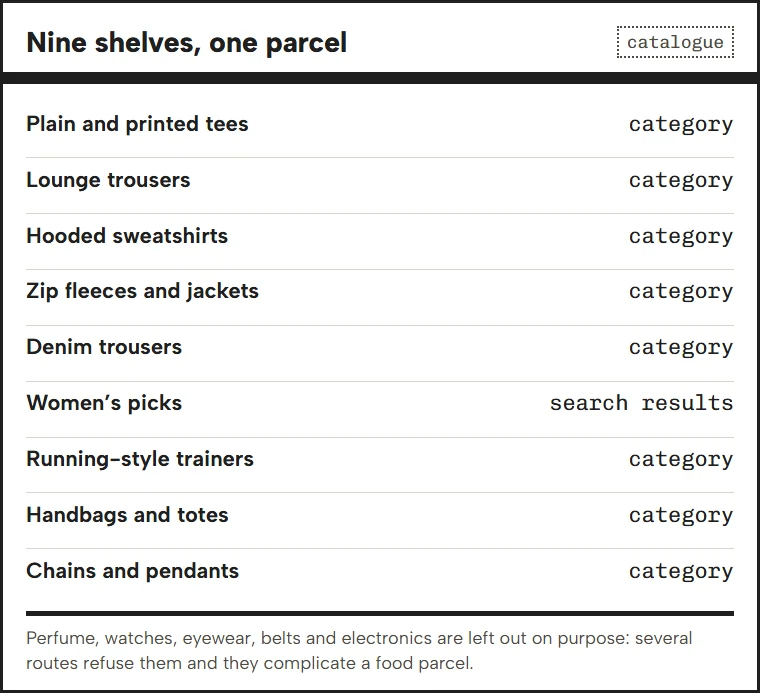
Five shelves you might expect are missing: perfume, watches, eyewear, belts and electronics. Several of the routes that accept food refuse liquids, batteries or brand-name goods, and those five shelves are where such items cluster. Keeping them out of a snack parcel keeps the route list open.
The women’s card is a search rather than a shelf, because the catalogue organises by garment type, not by who wears it. Expect a mixed page of dresses, coats and knitwear.
Labels on the cards are ours, written to say what each shelf is for rather than copied from the catalogue’s own headings. The photos come from listings on each shelf and show the kind of item you will find there, not a particular product we recommend.
If you plan one parcel for clothes and food together, do not assume a light item is unrestricted; check the actual material and contents category. Bulky shelves such as fleeces and trainers push the parcel into a higher weight band, where fewer food routes remain.
Nothing on these shelves is food. The next section explains why, and what to do instead.
Food is not a catalogue shelf, and that is fine
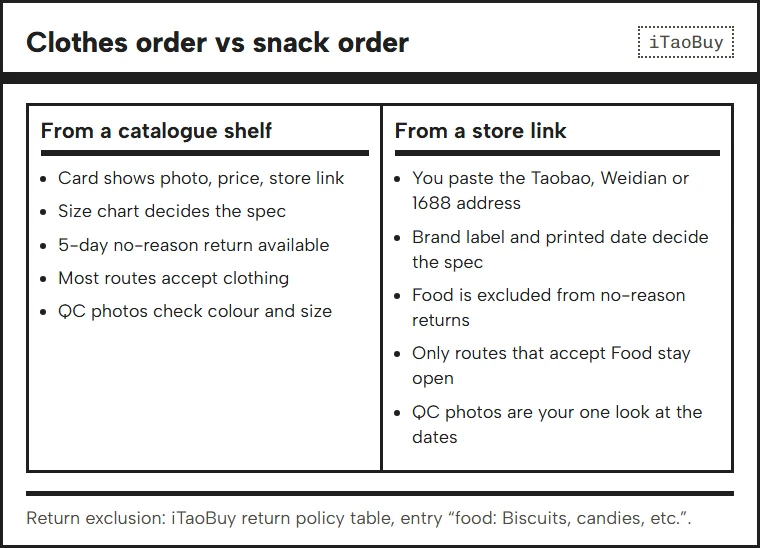
The catalogue grew out of clothing and accessories, and its shelves still reflect that. Snack listings live in thousands of separate stores, change flavours monthly and sell out, which suits a direct link better than a curated card.
So for food you start at the store. Copy the listing address from Taobao, Weidian or 1688 and paste it into iTaoBuy’s search; the listing opens as an order page. Before paying, look at the product photos for the things the notice cares about: a brand name on the pack and a printed date. A listing that only shows loose, unbranded goods in a bag is the Sanwu case the notice forbids.
The one place the catalogue helps with food is the parcel. If you are already sending a hoodie and jeans, adding sealed biscuits changes which routes you can pick. We tested that directly; see the next section.
A food find needs more than a product photograph
For a snack discovered through a seller link, record the exact product, pack size, ingredients and date information before asking the agent to buy. A similar wrapper or translated product name may refer to another flavour or formulation. Where a route decision depends on ingredients, obtain a readable label rather than inferring them from the front image.
The catalogue can help find ordinary goods, but its presence or absence does not decide food acceptance. Check agent purchasing rules, the proposed shipping line and destination requirements separately. If the food will travel with clothing, assess the mixed contents as one proposed parcel. Do not buy a restricted item on the assumption that it will automatically be removed or refunded later.
Adding snacks to a clothes parcel narrows the routes
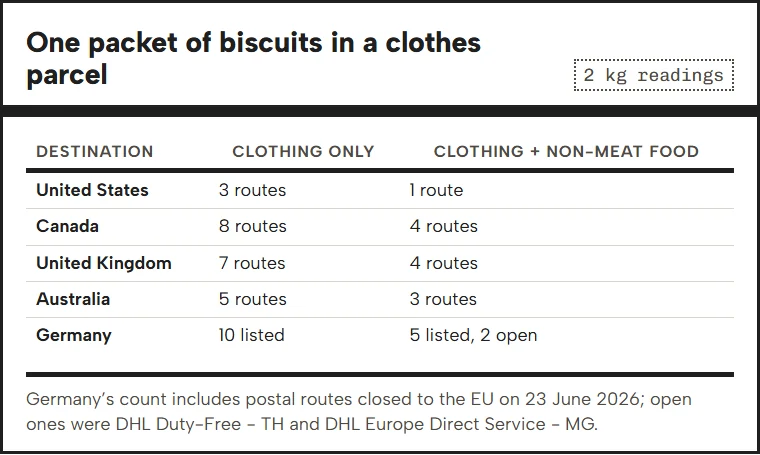
The estimator lets you tick several product categories at once, so we asked it about a mixed 2 kg parcel: clothing alone, then clothing plus Non-Meat Food. In every destination the mixed parcel was left with exactly the routes that accept food. To the United States, three routes became one, U.S. Line - F. To Canada, eight became four.
That has a practical consequence. The fastest or lowest-priced route for your clothes may refuse food, and one packet of sweets is enough to push the whole parcel onto a slower or pricier line. Two parcels, one with clothes and one with food, cost two operation fees but keep the clothing parcel’s full route list.
Whether splitting is worth it depends on the numbers on the day. The iTaoBuy freight estimator will show both options if you run it twice.
Why use this spreadsheet for a food parcel
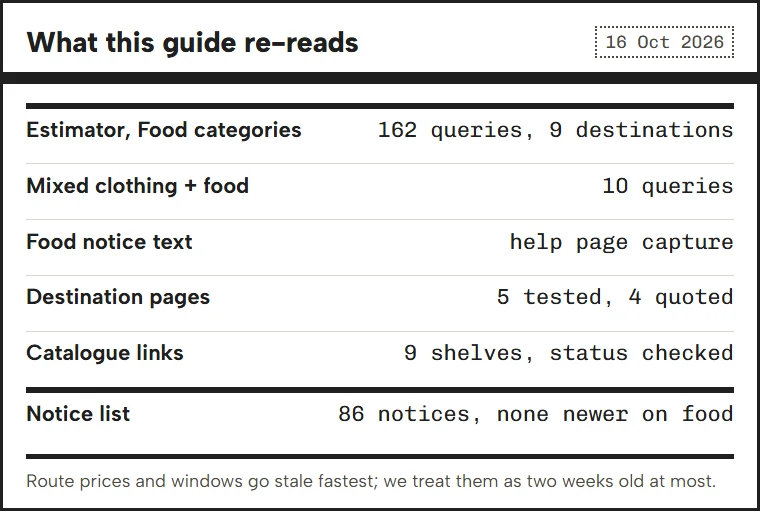
Plenty of catalogues will show you a hoodie. What this one adds is the food layer, and the only way to make that useful is to keep it dated. Every route on this site comes with the day it was read and the exact query: destination, weight, box size and food sub-category.
We also say what we could not check. The parcel submission page sits behind a login, so we cannot show how the declaration form looks for food. The Australian biosecurity site did not answer our tests, so we quote nothing for Australia rather than paraphrase from memory.
When a link dies or a route renames, the fix goes into the revision log on the About page. Corrections by email are welcome.