

What destination governments publish about posted food
Quoted word for word, with the date each page was read. No verdicts: a guide cannot tell you what a border will admit, and this one does not try.
How these pages were chosen and tested
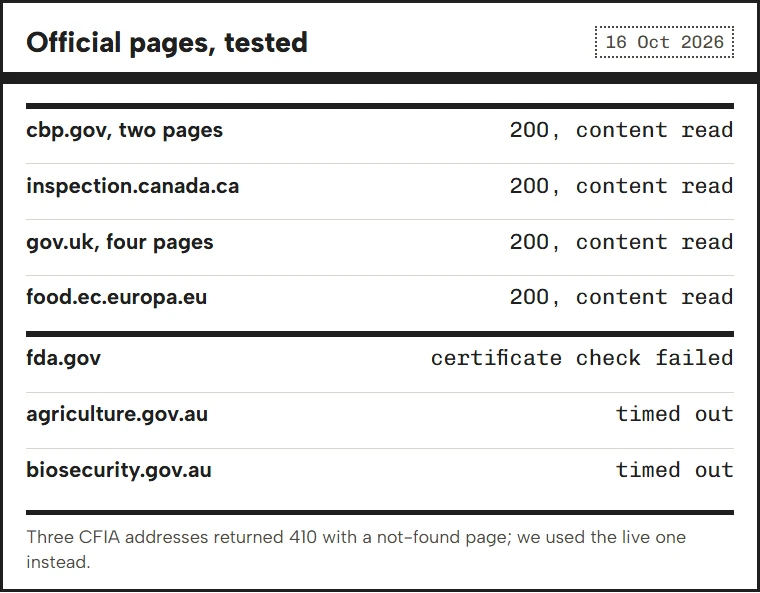
The notice tells you to “check destination customs regulations in advance”. That is good advice and hard to follow, so this page gathers the official texts for the destinations iTaoBuy names: the United States, Canada, the United Kingdom, Australia and Europe.
Each page was fetched on 16 October 2026 and its text read, because a page can answer with status 200 and still be a not-found page. Three older CFIA addresses returned 410; GOV.UK’s former guidance address returned 404. We link only pages that loaded with real content.
Two sources failed outright. The US Food and Drug Administration’s site failed a certificate check from our machine, and Australia’s agriculture and biosecurity sites timed out every time. Rather than paraphrase them from memory, we quote nothing for those two.
United States: Customs and Border Protection
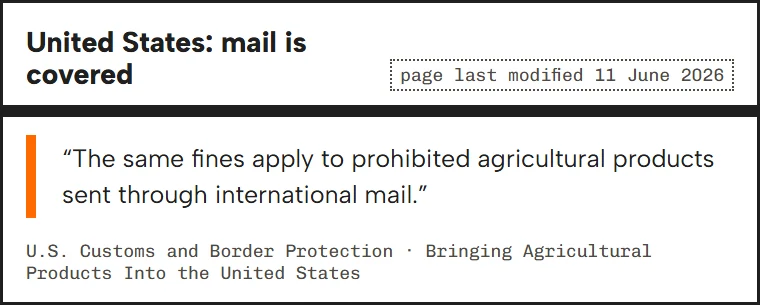
The same fines apply to prohibited agricultural products sent through international mail.
All agriculture items must be declared and are subject to inspection by a CBP Agriculture Specialist at ports of entry to ensure they are free of plant pests and foreign animal diseases. Prohibited or restricted items may include meats, fresh fruits and vegetables, plants, seeds, soil and products made from animal or plant materials.
The two CBP pages are written mostly for travellers, and the first one states that its fines also cover international mail. The second page sends readers to the Department of Agriculture for “generally allowed food items”. Meat is the category both pages name first.
Canada: the Canadian Food Inspection Agency
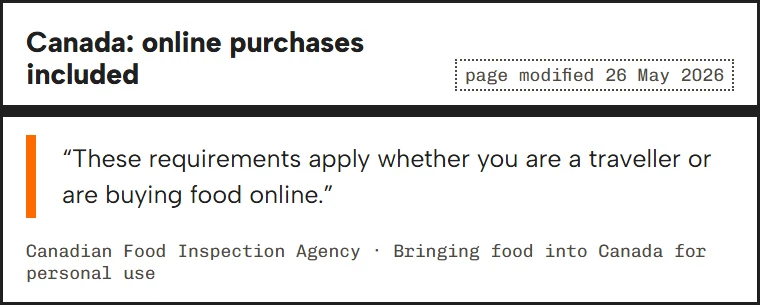
These requirements apply whether you are a traveller or are buying food online.
The CFIA page carries two tables, one for food from the United States and one for everywhere else. For other countries, the entry for confectionery, sweeteners and snack foods reads “Cannot contain meat”, with a 20 kg limit per person; condiments and dressings show no restriction and a 20 kg or 20 L limit; and eggs and processed egg products are “Not permitted”.
Some entries are marked “Permitted only if accompanied into Canada by you (cannot be brought in by mail or courier)”, animal fat or suet among them. For anything not in the tables, the page points to the agency’s import reference system.
United Kingdom: GOV.UK
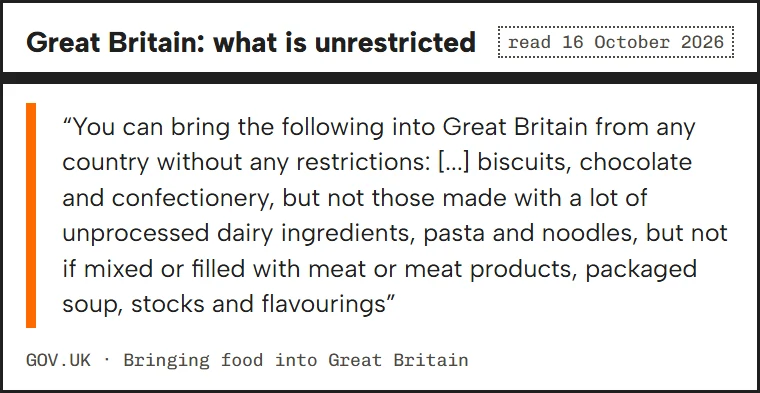
You can bring the following into Great Britain from any country without any restrictions: [...] biscuits, chocolate and confectionery, but not those made with a lot of unprocessed dairy ingredients, pasta and noodles, but not if mixed or filled with meat or meat products, packaged soup, stocks and flavourings
If you’re bringing food from a country outside the EU [...] You cannot bring in: meat or meat products, milk or milk-based products, except powdered infant milk, infant food or special food needed for medical reasons
The current guide is written for food you bring in “for your own use” and does not mention post. An older GOV.UK press release, dated 22 July 2010, said: “The rules apply to any products brought in personal luggage or sent by post (including those ordered online).” We cite it with its date because it is the most recent GOV.UK sentence on posted food we found. Northern Ireland has different rules, which the guide links to.
European Union: the Commission’s personal imports page
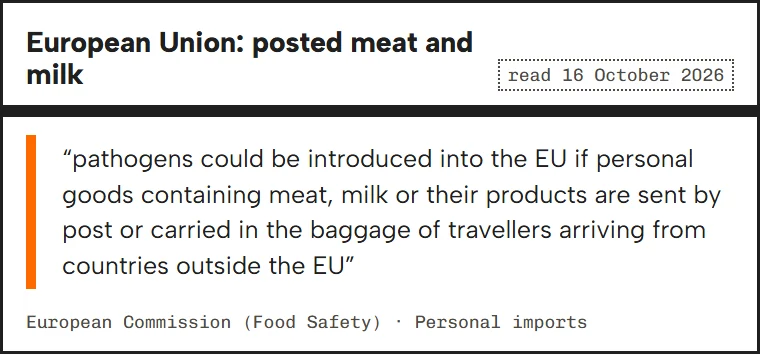
pathogens could be introduced into the EU if personal goods containing meat, milk or their products are sent by post or carried in the baggage of travellers arriving from countries outside the EU
The page cites Commission Delegated Regulation (EU) 2019/2122 and summarises it: travellers “are not allowed to bring in meat, milk or their products”, with small exceptions, including powdered infant milk under 2 kilograms in unbroken branded packaging. Honey falls under “other animal products” with a 2 kilogram allowance.
It also lists enforcement: controls at entry points, detector dogs and scanners, and “the seizure and destruction of personal consignments that are found to be in breach of the rules”. Each EU country adds its own customs rules on top; this guide does not go country by country.
Australia: no page quoted
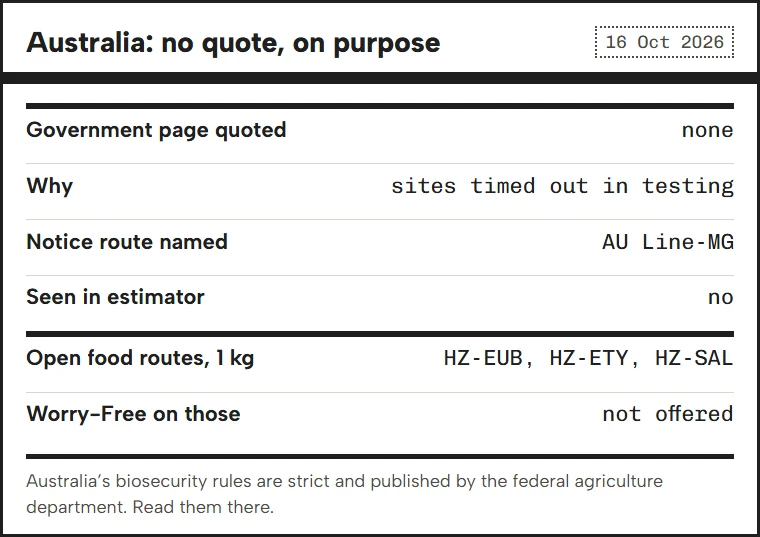
Australia appears in the notice as AU Line-MG and in the estimator as three postal routes that accept Non-Meat Food. What it does not appear as, on this site, is a quote. The federal agriculture department’s pages and the biosecurity portal timed out in every test we ran on 16 October.
We could describe what those pages usually say. We would rather not, because a paraphrase from memory is exactly the kind of statement this guide promises not to make. If you are sending food to Australia, read the federal biosecurity guidance on mail and online purchases yourself before you order.
The iTaoBuy side is clear enough: postal clearance, duties paid by you, no Worry-Free cover, and the notice’s meat warning and HZ-ETY liquid ban still apply.