

Choosing sellers, snacks and sites before an iTaoBuy food order
Most food parcel problems are decided before you pay: by the site you read, the seller you pick and the packet you choose.
Testing the catalogue site itself, this one included
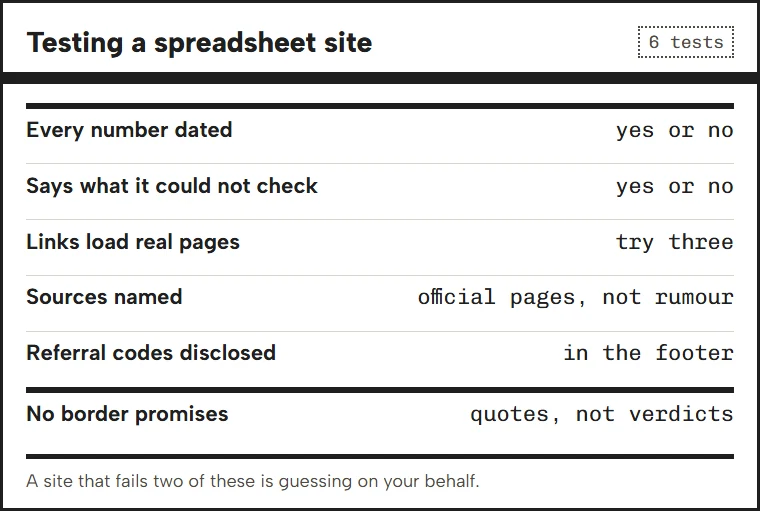
This is how to judge a spreadsheet site before you lean on it for food. A good one helps you find things and then gets out of the way. For food, add one more demand: every route, price and rule should carry a date, because all three change and nobody announces it.
Check whether the site says what it could not verify. We cannot see iTaoBuy’s parcel form behind the login and we could not load Australia’s biosecurity pages, and we say so. A site that never admits a gap has probably filled one with a guess.
Click three links at random. Dead links and redirects to unrelated pages are the quickest sign of an unmaintained list. Then look for the referral disclosure; every site linking to an agent with an invite code should say so.
Reading a seller’s food listing before you paste it
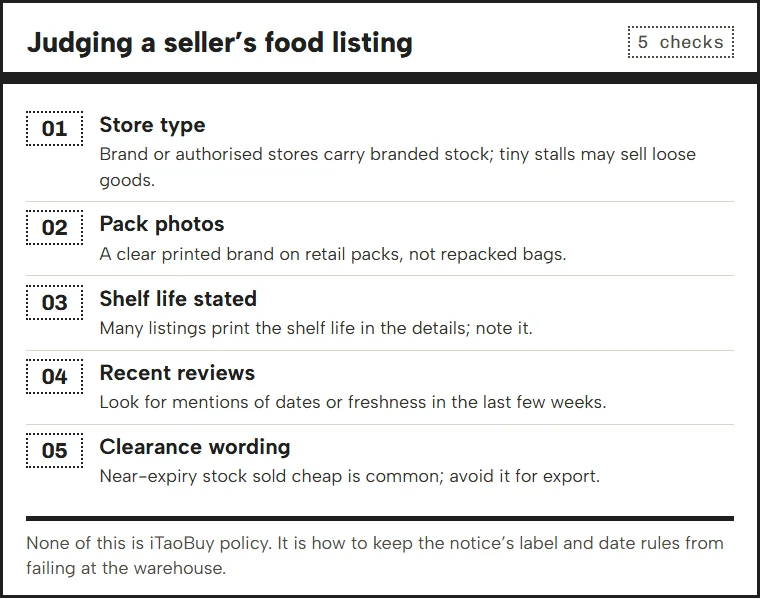
Good sellers for food are the ones whose stock looks like what the notice describes: retail packs with a maker’s brand printed on them. Brand stores and authorised resellers usually sell exactly that. Small market-style shops may repack sweets or dried goods into plain bags, which is how Sanwu products happen.
Read the listing details. Many Chinese food listings state the shelf life in a details table even when the photos do not show the date. Write it down; you will need it when the QC photos arrive.
Watch for clearance listings. A clearance listing may contain stock with little remaining shelf life; ask for the actual date before buying. It may fail the extra arrival buffer used by this site even if the listing looks inexpensive.
An agent’s food rules belong in writing
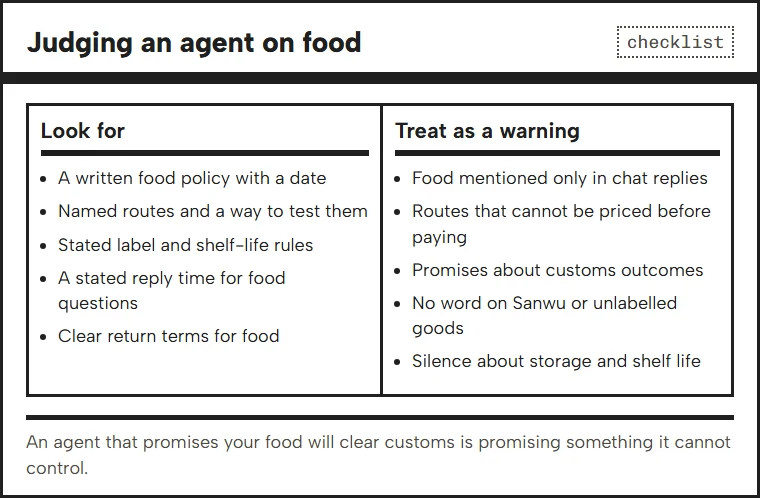
Most shopping agents look alike from the outside: they buy for you, store your items, photograph them and post them. What separates them on food is whether the rules are written down where you can read them before paying.
A trustworthy agent for food has a dated, public food policy, lets you price routes before you commit, says plainly what happens at customs and who bears the risk, and gives a reply time for questions. Be wary of any agent whose answer to a food question is a promise about the border.
Comparing agents is reasonable; just compare like with like. Put the same weight, destination and food category into each agent’s estimator on the same day, and compare list prices, not coupon prices.
Snacks that keep well in a parcel
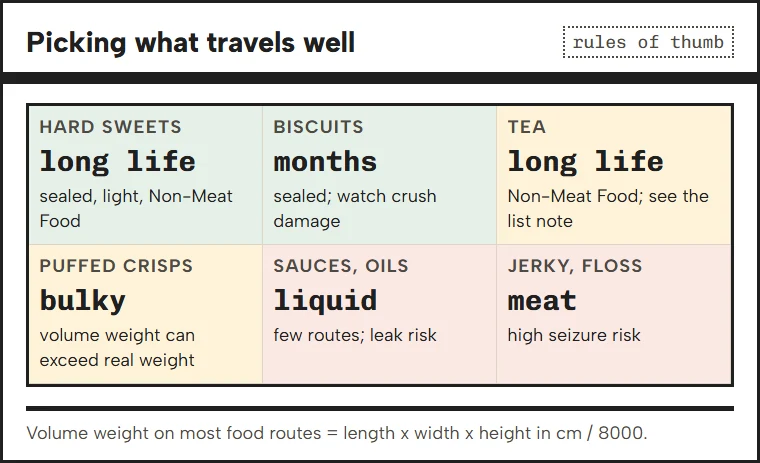
Picking a product for export is different from picking one to eat tomorrow. Start by checking retail sealing, visible branding and sufficient shelf life. Examples worth investigating include hard sweets, biscuits, packaged tea, instant noodles without meat-filled sachets.
Mind the air. Puffed crisps weigh little but fill a box, and most food routes bill the greater of actual weight and volume weight, length × width × height in cm divided by 8,000. A 30 × 20 × 10 cm box counts as 0.75 kg whatever is inside.
The items that cause trouble are the ones the notice and the destination pages single out: meat in any form, dairy, and anything liquid, pasty or powdered. If those are the whole point of your basket, read the page on the three flags before you order.
Five ways a snack parcel goes wrong early
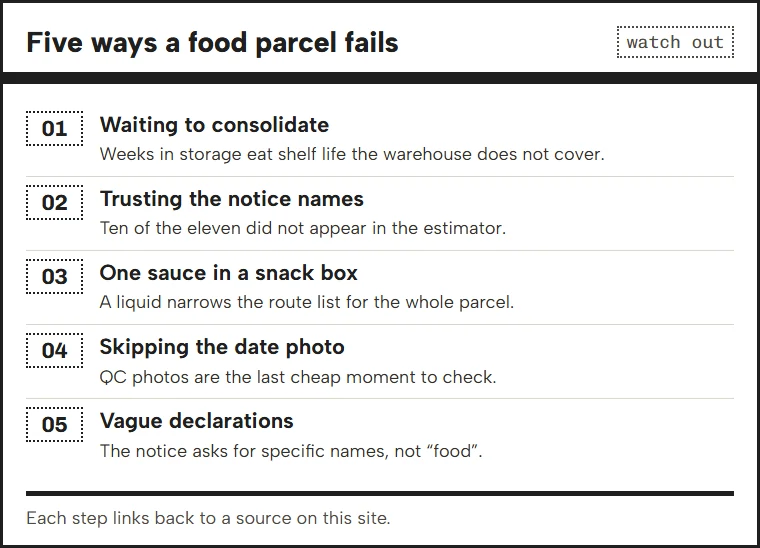
Waiting too long. Consolidating clothes may reduce repeated parcel charges, but weight and volume can offset that saving. With food, each week in storage is a week off the printed date, and the warehouse says it does not cover shelf life.
Trusting route names. The notice lists routes by names the estimator does not use. Pick from what the estimator shows on the day, with Food selected.
Mixing in one liquid. One bottle of chilli oil turns a Non-Meat Food parcel into a Liquid parcel, and the route list shrinks to what accepts both.
Skipping the photos. If the date is not visible, ask for a custom photo before you submit. Vague declarations. The notice asks for specific descriptions such as “biscuits” or “candy”, not “food” or “gift”. These checks reduce avoidable mistakes. They do not resolve seller quality, transit delays or destination restrictions.
Comparing iTaoBuy with the agents forums mention
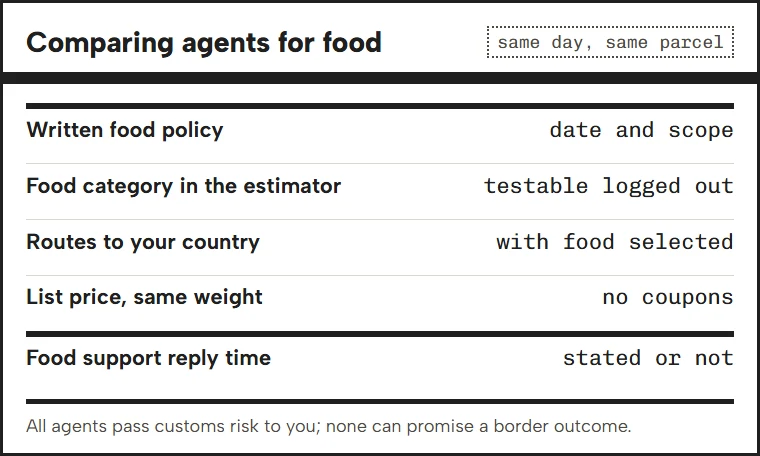
iTaoBuy is one of many shopping agents that buy from Taobao, Weidian and 1688 for overseas customers. Forums and catalogue sites mention several other shopping agents, and comparing them for a food order is sensible.
We do not name or rank them here, because we have only tested iTaoBuy’s food rules and estimator. What we can offer is the method: ask each agent the same questions on the same day, for the same parcel, and keep the answers with their dates.
If another agent has no written food policy at all, that is an answer too. The value of iTaoBuy’s April notice is less that it allows food than that it says, in writing, what it expects from you.