

Labels, expiry dates and a practical shelf-life buffer
The official notice asks for a brand label and printed date, and recommends three months of remaining shelf life. This guide explains the date calculation and a separate conservative arrival buffer.
A brand label and a printed date, defined
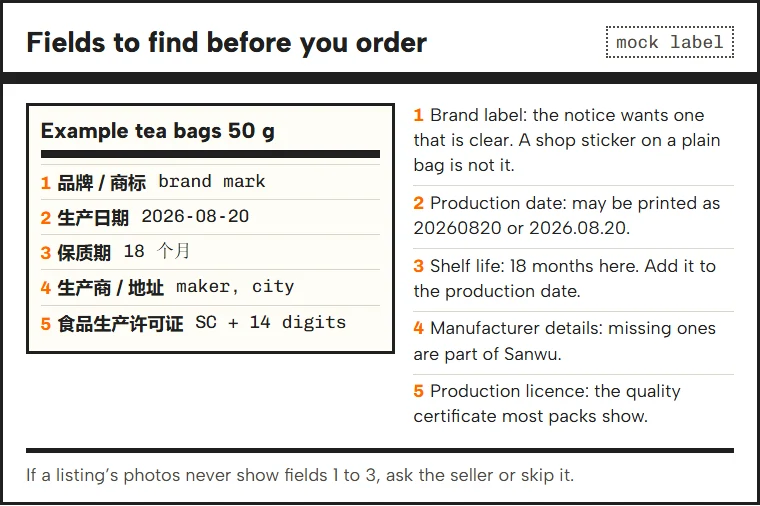
Section II.1 of the 3 April 2026 food notice asks for “a clear brand label and an expiry date (production date or best-before date)” on every food item. In practice that means the pack itself, not a sticker the shop adds and not a zip bag with a handwritten note.
Chinese pre-packaged food usually prints its dates in a fixed panel. The production date is often stamped on the crimped seal or the base in eight digits, such as 20260820. The shelf life is printed as a period, for example 12 months or 180 days, and the reader is expected to do the sum.
Listings rarely show the date panel in their photos, because dates change with every production run. You see the real pack only in the warehouse QC photos, after you have paid. That is why the label check sits first in our pre-check and again in the warehouse page.
Sanwu: three things a pack must not lack
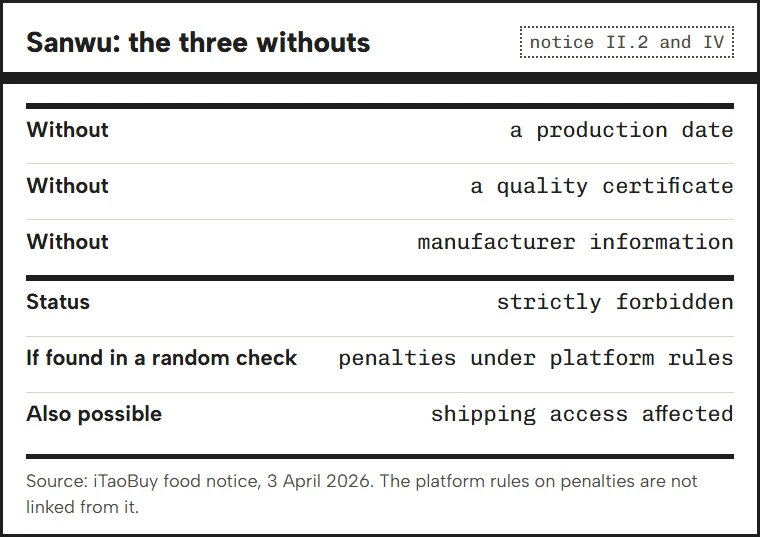
Sanwu, pronounced roughly “san-woo”, means “three withouts”. The notice spells them out: no production date, no quality certificate, no manufacturer information. Products like that are “strictly forbidden”.
It is a familiar idea in China, where market stalls sell loose sweets, home-made chilli sauce and dried meat in plain bags. Those can be lovely and also exactly what this rule excludes. Small handmade-snack shops on Taobao and Weidian sometimes ship the same way.
Section IV adds the enforcement: the platform may randomly inspect suspicious parcels, and if Sanwu or prohibited items are found, “penalties will be imposed according to platform rules, and your shipping access may be affected”. A whole parcel can be held for one unlabelled bag.
Working out expiry from a production date
Many packs give you a production date and a shelf life instead of a best-before date. The notice accepts either. You have to turn the first kind into the second.
- Printed production date20 Aug 2026from the seal
- Printed shelf life18 monthsfrom the panel
- Expiry you work out20 Feb 2028date + 18 months
- Short month case31 Aug + 6becomes 28 Feb
- Days format180 dayscount days, not months
Adding months to a production date. The pre-check does the same, and clamps to the last day of short months.
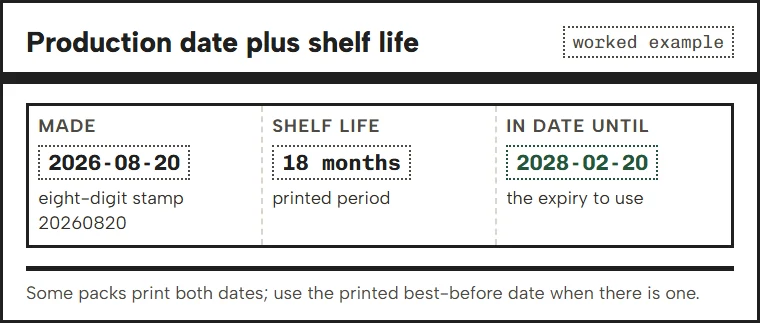
Add the shelf life to the production date. Tea made on 20 August 2026 with an 18-month shelf life is in date until 20 February 2028. When the shelf life is in days, count days: 180 days from 20 August is 16 February 2027, a different answer from six months.
Short months need care. Six months after 31 August is not 31 February; the pre-check clamps to the last real day, 28 February. If you are close to the line, assume the earlier date.
When a pack prints both a production date and a best-before date, the best-before date is the one to use. When it prints neither, you have reached the Sanwu rule again.
Our conservative buffer: three months after the slow end
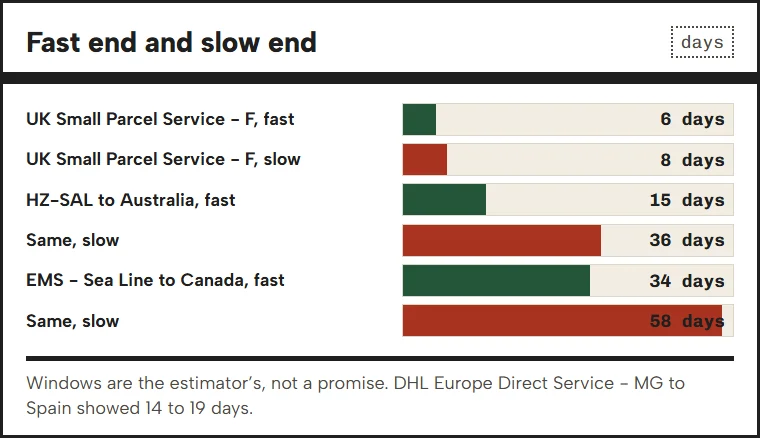
The notice recommends “at least 3 months of remaining shelf life, to avoid expiry during transport and customs clearance”. Remaining when, it does not say. Our tool adds three months after an estimated slow-end arrival as an editorial safety margin. That timing is not stated by iTaoBuy and is not an official eligibility deadline. The transit window is an estimate, not a guaranteed arrival date.
The difference is not academic on slow routes. EMS - Sea Line to Canada showed 34 to 58 days; its own description says about 30 to 40. HZ-SAL to Australia showed 15 to 36. A packet with four months left on the order date can be fine on the fast end and short on the slow end.
Customs time is extra. The notice mentions it by name and gives no figure, so neither do we. If your packet only clears the line by a week, pick a packet with more life in it.
The tool also works the other way round. Enter a packet’s expiry and it tells you how many days of margin remain past the line, so you can compare two flavours or two shops before ordering.
The warehouse clock counts too
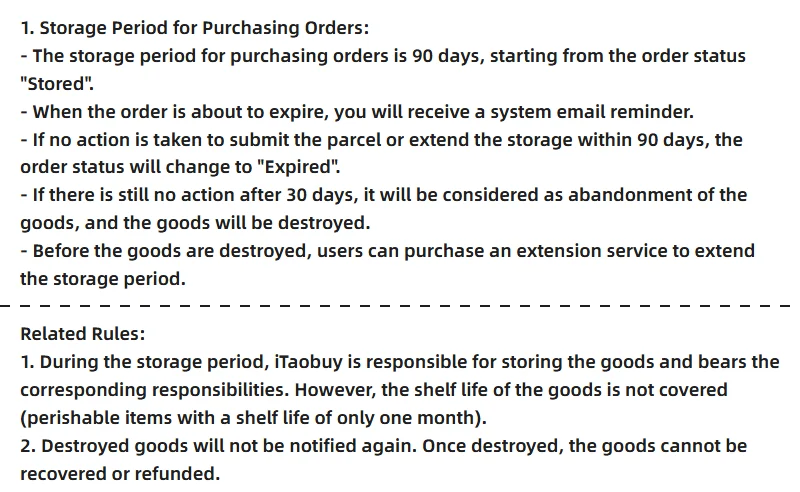
Normal purchased-order storage at iTaoBuy lasts 90 days from the moment an order shows Stored. You get an email before it ends; then the status becomes Expired, and after 30 more days without action the order counts as abandoned and is destroyed, with no further notice and no refund.
For food, one sentence on that page matters more than the 90 days. Under Related Rules: iTaoBuy “is responsible for storing the goods and bears the corresponding responsibilities. However, the shelf life of the goods is not covered (perishable items with a shelf life of only one month).”
Do not treat warehouse storage as a promise to preserve a food item’s shelf life. The quoted exclusion and the condition of your actual goods matter; contact support promptly about damaged or already-expired stock. The habit many buyers have, letting orders collect for weeks before one big parcel, is the habit to drop when food is in the mix. Enter your real waiting time in the pre-check’s days-before-dispatch box.
Storage is not one clock for every parcel
The 90-day purchased-order clock starts at Stored. The separate unmatched forwarding rule uses Signed and a 30-day limit without reminders. Identify the order type before using either date. A paid extension of normal storage does not extend the expiry printed on food.